
ECC (Error-Correcting Code) memory differs from standard memory mainly in how it handles errors and where it is used:
Error handling:
ECC memory contains additional circuitry that detects and automatically corrects single-bit errors and detects more serious multibit errors. This helps prevent problems that can cause system crashes or application errors.
Standard, non-ECC memory does not have this error correction feature. It is more vulnerable to errors that may cause crashes or system instability, although these are rare in typical use.
Applications:
ECC is mainly used in servers, workstations and critical systems, such as banking and scientific research, where reliability is essential.
Standard, non-ECC memory is typically used in consumer computers such as laptops and desktops, where protection against bit errors is less of a priority and users seek performance at a lower cost.
Buffering and stability:
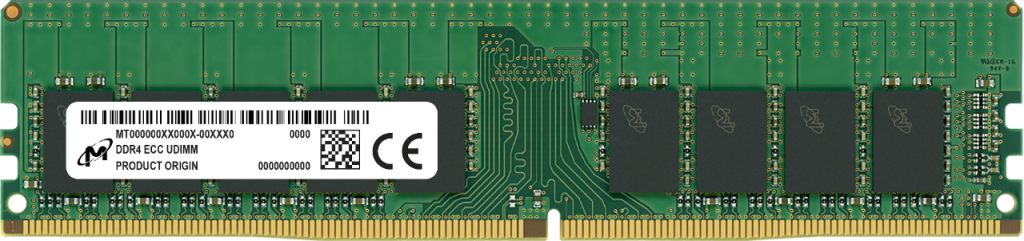
Unbuffered ECC memory (ECC UDIMM) is typically used in systems that need ECC protection but do not require the extra stability provided by buffered memory.
Buffered ECC memory (RDIMM) also includes registers that help stabilise signals under heavy loads. It is slower than unbuffered memory and is used mainly in large servers and workstations.
As a result, unbuffered ECC is more reliable than standard memory but does not match the stability of buffered memory, making it a compromise between cost and stability for midrange servers and workstations.
ECC (Error-Correcting Code) memory is usually not compatible with standard motherboards, particularly gaming and consumer models from brands such as ASUS, MSI and Gigabyte. These boards generally do not support ECC, as it is typical of servers and professional workstations based on Intel Xeon or AMD Ryzen PRO processors. Some AMD Ryzen processors can use ECC unofficially if the motherboard supports it.
ECC compatibility
ECC memory works properly only when both the motherboard and processor support it. If ECC modules are installed in a consumer motherboard, they will most often operate in non-ECC mode, without error correction. The ECC function is then disabled and the memory works like ordinary RAM.
Does ECC make sense for music production?
ECC memory is usually unnecessary for music production because audio processing and recording do not require the same level of reliability and error protection as servers or critical research applications. System stability matters in music, but the risk of bit errors that ECC could correct is marginal. The additional cost of ECC memory therefore brings no measurable benefit in a typical music production environment.
In summary, I see no practical reason to use ECC memory for typical music production, and standard gaming motherboards do not support the feature.